
Carter, Mo’unga, Cooper, Libbok: Meet the S&C guru behind rugby’s elite No.10s

Updated: Dec 5, 2025
Dan Carter’s discipline. Richie Mo’unga’s energy. Quade Cooper’s edge. Kintetsu Liners’ head strength and conditioning coach Takeshi Sakaguchi has trained elite number 10’s and he’s just started working with Springboks Manie Libbok. In this exclusive RugbyJP.com interview, Sakaguchi explains how Japanese rugby is evolving and why consistency, detail and mindset define world-class players.
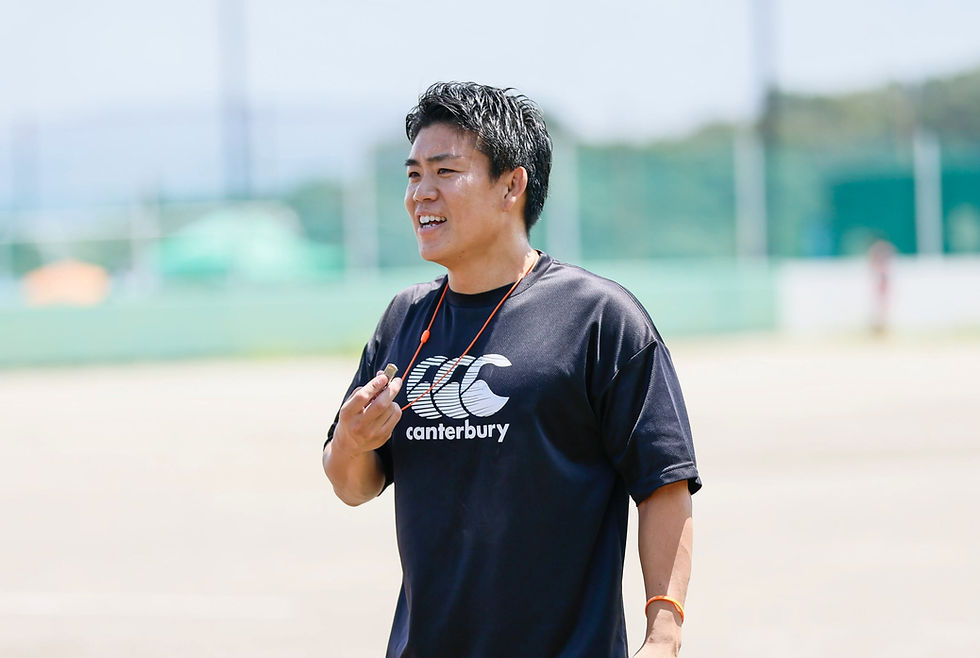
Sakaguchi has established himself as a go-to authority on strength and conditioning in Japanese rugby.
His background is in baseball which he credits for teaching him the importance of high standards in a high-performance environment.
“I actually didn’t play rugby myself, I played baseball for nine years, and that experience taught me the importance of physical preparation and discipline,” he told RugbyJP.com.
Sakaguchi graduated from Tokyo’s Juntendo University with a degree in Exercise Physiology in 2011 and stared working with American football side Asahi Soft Drink Challengers.
The Moriguchi, Osaka native landed his first rugby job in 2017 when he joined Dave Dillon’s star-studded Kobe Steelers.
Their ranks included All Blacks great Dan Carter, Wallabies star Adam Ashley Cooper, ex-All Blacks scrum-half Andy Ellis, former Brisbane Broncos wing Fraser Anderson and future All Blacks and Wallabies prop Aidan Ross.
Top League glory followed in 2018 with Carter brilliantly leading Kobe, who also recruited the legendary Wayne Smith as their Director of Rugby, to an emphatic 55-5 win in the final over a Matt Giteau’s Suntory Sungoliath.

Sakaguchi was Toshiba Brave Lupus’ strength and conditioning as Richie Mo’unga’s steered them to their first League One title in 2024.
Last season he worked for division two side Hanazono Kintetsu Liners whose promotion charge was led by outgoing Wallabies legends Will Genia and Quade Cooper.
Sakaguchi explained his strength and conditioning philosophy.
“Each player has different characteristics, so I adapt the program to the individual. For example, if a player’s strength levels are relatively low, we focus on improving strength. If a player needs more muscle mass, we emphasize hypertrophy work.”
Carter and Mo’unga, for example, were world-class, world-renowned stars in their prime years when they started working Sakaguchi in Japan.
“With players like Carter, Mo’unga, and Cooper, they already had the ability to handle heavy loads, so the focus was on maintaining their strength while improving movement speed.
“Another key part of my philosophy is injury prevention. I take into account each player’s injury history and any imbalances and include specific exercises to strengthen areas that are more vulnerable.”
Two-time World Cup winner Carter, who was the All Blacks’ starting number 10 at the 2007, 2011 and 2015 World Cups and his successor Mo'unga, who wore the iconic jersey at the 2019 and 2023 tournaments both the domestic league title and MVP awards in their first season in Japan.
Sakaguchi hailed the work ethic of both players.
“Both Carter and Mo’unga had excellent approaches to strength and conditioning. They were hard workers and true professionals who understood exactly what they needed to do and how much was required. Through working with them, I was also able to learn a great deal myself.”

The game’s elite players require cutting edge technology to keep improving, and the evolving world of strength and conditioning has undergone a huge overhaul with advancements in data and science.
Japan’s premier competition, League One, launched in 2022 as a fully professional league - with three divisions - which has unlocked greater resources for strength and conditioning.
Sakaguchi outlined what he sees as the biggest changes in strength and conditioning approaches in Japanese rugby over the past decade.
“One of the biggest changes has been the use of technology, especially GPS. Coaches now rely not only on subjective measures but also on objective data to monitor training loads and each player’s condition. This has made programs far more data-driven and individualised.
“Another major shift has been in the structure of support. In the past, S&C and medical staff often worked separately, but now they function together as a high-performance team, managing the entire process from return-to-play through to performance development."
After successful spells with Kobe and Toshiba, the in-demand coach is currently preparing a talented Liners squad for the 2025-2026 season which kicks off next week.
The Osaka-based team, whose squad features ex-New Zealand number eight Akira Ioane, once-capped All Black Peter Umaga-Jensen and Libbok, open their season away to last year’s second division title winners Toyota Industries Shuttles Aichi on Saturday 13 December.
Sakaguchi wants to bring some of the key character traits from the triumphant Kobe and Toshiba groups he worked with to the promotion-chasing Liners.
“What I learned at Kobe and Toshiba was the importance of high standards. In those top clubs, every player held themselves to a very high level — in training and in S&C they always worked hard, were tough, and showed independence. There was also a strong team culture where even the most demanding work was approached with a positive mindset.
“That is the kind of culture I want to bring into Kintetsu: a team environment where high standards and a positive approach are part of our everyday habits.”
The club’s playmaking responsibilities have been passed from 2011 Tri Nations winner and 2015 World Cup runner-up Cooper to Springboks ace and 2023 World Cup winner Libbok.
Cooper – along with his long-time teammate and half-back partner Will Genia - called time on his career after six seasons with the Liners in the summer but has returned to Osaka to begin his coaching career.
Attack coach Cooper and skills coach Genia are part of a new-look coaching setup which also includes defence coach Tai Lavea and forwards coach Ross Filipo while former coaching coordinator and ex-captain Haruki Ota has been promoted to head coach.
Liners fans are optimistic about the changes while Springboks fans have been enthusiastic about Libbok getting the opportunity to work with Cooper and Genia – in particular - on a daily basis.
Sakaguchi told us what stood out the most to him about Cooper the mercurial playmaker as well as Carter and Mo’unga.
“What impressed me most was that all three had completely different approaches, yet each was highly effective.
“Dan Carter was extremely professional and consistent — he would plan his entire week in advance, from recovery to mental preparation, and execute it with discipline.
“Richie Mo’unga brought great energy and a sense of enjoyment to his rugby. He had a clear weekly workout routine leading into games, and his body management to reach peak performance on match day was very sharp.
“Quade Cooper had his own unique style, with a strong focus on gym work and mobility, always looking for a physical edge.
“What I learned from them is that there is no single ‘correct’ way to prepare. The key is establishing a routine that fits your personality and allows you to perform at your very best.”
We asked the highly-respected Sakaguchi what separates world-class players from their peers when it comes to physical preparation.
“For me, the difference comes down to consistency and attention to detail,” he said.
“World-class players never cut corners — they approach every session with full focus, and they simply do more. I still remember Dan Carter staying out on the field after training had finished, being the very last player to leave as he worked on his kicking.
“Another key factor is mindset. The best players don’t see physical preparation as an obligation, but as an essential part of being a professional. That mentality not only drives their own performance but also raises the standard for the entire team.”
Liners’ new arrival Libbok, who makes his club debut in the final pre-season game against Kobe on Friday, will be driving the team and standards for the club this season.
One of the areas Sakaguchi has been tackling is to ensure the squad’s physical standards are at the highest level in order to provide a platform for a playmaker of Libbok’s calibre.
“To play high-quality rugby, the physical foundation is essential. Sufficient strength and power provide dominance at the contact area and in the forwards’ set-piece, while speed and the fitness to sustain intensity for 80 minutes are what support the backs.
“If the squad is physically strong and consistent, it allows Manie to fully showcase his strengths. So, raising our physical standards is not just about matching him, but about maximising his impact within the team.”

Sakaguchi revealed how he ensures that players buy in to the process and demanding gym programs during a long and demanding season.
“The key is clarity,” he explained.
“Players buy in when they understand why we are doing something and how it directly connects to their performance. That’s why I always explain the purpose of each session and use data to make changes in performance visible.
"Another important factor is individualisation. When players feel that their program is tailored to their needs — whether it’s recovery, speed, or strength — their level of engagement grows significantly.
“Finally, it comes down to trust. When players see that the S&C staff are consistent in their support and aligned with the coaches, they understand that we are here to help them succeed. That trust is what drives buy-in throughout a long and demanding season.”
Despite boasting a well-stocked resume, Sakaguchi is still diligently honing his craft and recently visited Australian National Rugby League (NRL) clubs Melbourne Storm and Parramatta Eels.

“The purpose of my visit was to learn two things: firstly, how I can contribute as a Head S&C coach to building team culture, and secondly, how I should lead both the S&C department and the team as a whole,” said the former Kobe University American football team coach.
“What I learned is that an S&C coach must consistently set high standards for players, and use their knowledge to create a “football-first” program. At the end of the day, the athletes I work with are rugby players, and everything they do in training is ultimately to become better rugby players.
“To build a high-quality rugby program, it’s essential to spend time with the coaches, understand what they value from both a football and physical perspective, and learn what style of play they want and what qualities they want their players to have. Importantly, I realized it’s not just about accepting those ideas, but also about engaging in respectful discussions and robust conversations. That process helps both sides achieve what is really needed.”
Since the club game in Japan turned professional in 2022 and with Brave Blossoms head coach Eddie Jones championing 'chosoku rugby', meaning super-fast rugby, the domestic game has become faster and more skill-focused.
This has influenced the physical preparation of players and the demands of them.
“The shift toward a faster, more skill-focused style has had a major impact on physical preparation. The key demand now is the ability to repeat high-speed efforts — not just having top-end pace, but being able to produce high-intensity actions repeatedly throughout the match.
“At the same time, the increased speed of the game means collisions happen at higher velocity, which raises the demand for robustness and durability. With more matches in the season, players also need the toughness to sustain those high-intensity performances week after week.
“In addition, the ball-in-play time has increased, which makes fitness and the ability to maintain intensity for longer periods an essential part of preparation.
Sakaguchi added: “In today’s Japanese rugby, players must be not only fast and skillful, but also resilient, durable, and fit enough to handle the volume and intensity of the modern game.”


Quería entender cómo se calcula el promedio cuando hay asignaturas donde el profesor permite que los estudiantes corrijan sus errores en una segunda entrega para mejorar la nota original obtenida en la primera instancia. Este sitio lo explica con total claridad mostrando cómo esa posibilidad de mejora se integra al cálculo del promedio final de la asignatura dentro del sistema chileno. Los ejemplos numéricos son muy fáciles de seguir y cubren exactamente ese tipo de metodología pedagógica flexible que cada vez más docentes universitarios chilenos están implementando activamente. Un contenido muy actualizado que refleja tendencias pedagógicas contemporáneas que generan mucha confusión entre los estudiantes que no entienden bien sus implicancias en el promedio. https://calculadoradenotas.cl